
Module 04 / Simulation workbench
Built-in FEA that lands within 0.6% of the NAFEMS LE1 target.
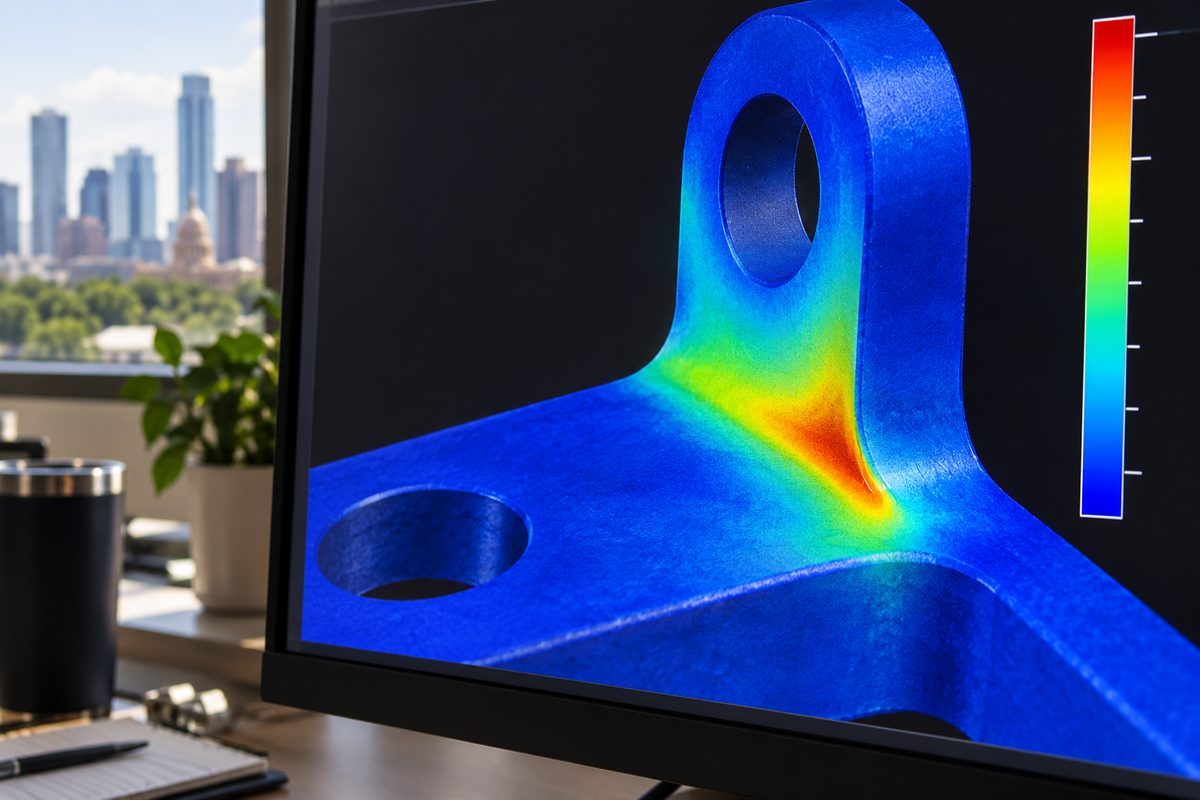
This is CAD with built-in FEA for the checks a mechanical team runs every week: linear static, modal and steady-state thermal, on meshes up to 2 million elements, inside the same window you model in. We publish our NAFEMS LE1, LE5 and T1 numbers below. The solver comes with a Professional seat at $3,890, or lifts a Standard seat for a one-time $1,590.

04.1Verification
NAFEMS benchmark results, with the mesh we used
Three standard problems from the NAFEMS linear and thermal benchmark set. Each one ships as a project file in the installer's verification folder, so you can rerun it and get our number.
NAFEMS / LE1 · LE5 · T1
| Test | Quantity | Target | Result | Error | Mesh |
|---|---|---|---|---|---|
| LE1 elliptic membrane | σyy at point D | 92.7 MPa | 92.15 MPa | −0.59% | Quad-8, 1,120 el. |
| LE5 Z-section cantilever | σxx at point A, mid-surface | −108 MPa | −107.1 MPa | −0.83% | Tet-10, 41,600 el. |
| T1 plane membrane, 2D heat | Temperature at point E | 18.3 °C | 18.26 °C | −0.22% | Tri-6, 2,480 el. |
Direct sparse solver, default tolerance, Windows 11, desk-tier machine.Rerun: verification/NAFEMS-*.swsx
LE1 punishes coarse meshes at a curved boundary. With linear quads at the same density the error is over 9%, which is why the mesher defaults to second-order elements and why we do not let you switch that off without a warning. LE5 is the harder one: a warped section under torsion, where solid elements have to catch a bending stress through a thin flange. Under 1% at 41,600 elements is a fair result. It is not the best number anyone has published, and we do not claim it is.
If you run a CAD simulation NAFEMS benchmark on a competing package and want to compare, use the same mesh counts. Error figures without the mesh are not worth reading.
04.2Solvers and elements
What the solver handles today, and its limits
- Linear staticForces, pressures, bearing loads, remote loads, gravity, centrifugal. Fixed, pinned, roller and elastic supports. Bonded contact between assembly bodies.direct sparse · PCG
- ModalFirst 1–200 natural frequencies and mode shapes, free or constrained, with prestress from a linear static study.Lanczos
- Thermal, steady-stateConduction, convection coefficients, heat flux, heat generation, fixed temperature. Temperature field can feed a static study as thermal load.direct sparse
- Element: Tet-10Second-order tetrahedron, default for solids.3D solid
- Element: Hex-20Swept meshes on extruded and revolved bodies.3D solid
- Element: Shell-8 / Tri-6Mid-surface shells extracted from sheet-metal and thin bodies.shell
- Element: Beam-3Structural members from weldment profiles.beam
The mesh limit is 2,000,000 elements per study. On 32 GB of RAM a 2M Tet-10 static solve takes about 6 minutes with the direct solver and 3 with PCG at default tolerance. Above that the solver refuses rather than paging to disk for an hour. If your model needs more, export the mesh as a Nastran bulk data deck or Abaqus .inp and run it on the cluster you already have.
Results carry the units you modelled in. Probes, section planes, safety factor against yield and a convergence plot over three refinement passes come with every study. Reports export as PDF/A-2 with the mesh statistics on page one, because that is the first thing a reviewer asks for.
04.3Catalogue item
Simulation add-on for Standard owners
-
Simulation add-on
$1,590one-time per Standard seat
Lifts an existing Standard seat to the full Professional solver set without replacing the licence. Linear static, modal and steady-state thermal, all element types above, the verification projects and the Nastran and Abaqus mesh export. Your licence key gains a flag; nothing is reinstalled.
It suits a shop that bought Standard for modelling and drawings and now wants to stop sending every bracket check out to a consultant. Standard plus add-on is $4,080; buying Professional outright is $3,890. If you are buying new, buy Professional.
- Requires
- Standard perpetual seat
- Delivery
- Updated key by email
- Floating Professional, per concurrent seat
- $4,890

List prices in USD. Every purchase is a quote request answered within one business day; nothing is charged online. Full licence terms are on Pricing.
We reran LE5 ourselves before buying. Same mesh, same number. That was the whole evaluation.

04.4Evaluation
Four steps to a solver you trust
- 01
Request the trial
The 30-day trial is a full Professional seat, solver included. Installer link within one business day.
- 02
Rerun the three NAFEMS files
Open the verification folder, solve, compare against the table above. Under an hour on a desk-tier machine.
- 03
Solve one part you have already validated
Take a study you trust from another tool or a strain-gauge test. Same loads, same restraints. Send us the comparison if it drifts more than 3%; support reads every one.
- 04
Buy Professional or the add-on
Quote by email. Perpetual, so the solver you validated stays the solver you own.
04.5Questions
Before you drop a separate FEA seat
Not for crash, fatigue, fluids or large-deformation rubber. Keep your specialist tool for those.
Can it replace Ansys or Abaqus?
For linear static, modal and steady-state thermal checks on parts and mid-size assemblies, many teams stop needing a separate seat. For contact-heavy nonlinear work, explicit dynamics or CFD, no.
When do nonlinear and transient arrive?
Both are scheduled for release 2025.2. Owners on a current maintenance year receive them at no extra charge. CFD is not on the roadmap.
Can I export the mesh to another solver?
Yes, as a Nastran bulk data deck or Abaqus .inp, with material and boundary conditions attached.
How does it compare with SolidWorks Simulation or Inventor Stress?
Same class of problem: linear and modal inside the modeller. The difference is that our verification files are in the box and our numbers are on this page. As an Inventor alternative or SolidWorks alternative for simulation, judge it by rerunning them.
Next
Rerun LE1 on your own machine this week.
Assemblies you load here are covered on Assembly. Shell meshes come straight from Sheet metal bodies. Results go onto sheets via Drawing, and the toolpaths that follow live in CAM-Post.